
Planetarium FAQ
If there’s something about Planetarium that you don’t understand, perhaps these extensive Frequently Asked Questions will clear it up for you. You could also try looking in the glossary.
- About the project:
- About the puzzles:
- About the solutions:
- About the competition:
-
About the story:
- Can you remind me whenever a new instalment is available?
- I can’t make any sense of the story. What’s going on?
- Is it possible to find out what the love-letter in the first picture actually says?
- What happens if I go on holiday and miss an instalment?
- What’s this about Blue Fuel and the Device for Generating Chess Openings?
-
About technical things:
- Is there an RSS feed for Planetarium? Where is it?
- The pictures are too dark/small/fuzzy. What can I do?
- I registered but I can’t log in. What’s wrong?
- How can I be sure nobody else can see my Table of Solutions?
- Have I got the right kind of browser, or am I missing something?
- I’ve forgotten my password. What can I do?
- I think I’ve found an error. What should I do?
- About something else:

About the Project
What is it, actually?
An on-line puzzle story in twelve weekly instalments
- on-line
Planetarium keeps track of the readers’ solutions as answers are submitted and keeps a virtual finger on which instalment each reader is currently in. Unlike a book, you have to explore the illustration to get to the words (you generally have to click on something in the picture to get the text about it, and piece the story together yourself). - puzzle
Planetarium is a puzzle which itself depends on the answers to 36 smaller puzzles (that’s 3 a week over 12 weeks). However, you don’t need to solve, or even find, the puzzles in order to enjoy the story. And at the end, we’ll tell you the answers anyway. - story
Planetarium is first and foremost a story, albeit illustrated and delivered in an unusual way. A curious story with something of an agenda, perhaps, but it is nonetheless a story which will appeal to people who like to read. One major UK internet provider told us that Planetarium has “too many words” — their subscribers’ limit was reckoned to be, approximately, half a screen of text. That’s probably true, so Planetarium is not for them. It’s a story with words in it. - in twelve weekly instalments
As soon as you start, Planetarium begins for you: a new instalment released every week, counting from the time you began. It doesn’t matter if you join in late, because it starts afresh for every reader. Planetarium was released on 9/9/99, and runs for ever.
What do I win if I solve it?
No prize. Planetarium is first and foremost a storytelling project on the web, and we hope you join in because it’s entertaining, not because you’re motivated by some greedy Winner Ethic, heaven forbid. If you don’t believe us, see the What’s the catch? question.
Planetarium was released on 9/9/99 and twelve weeks later, these people had solved it (it takes twelve weeks to collect all the puzzles, you see). If we were in the USA, we’d call this the Planetarium Hall of Fame, or something. However, the Beholder Six Beasties project had this to say about Halls of Fame . . . so you’ll see we’re unlikely to be having one of those.
It’s almost impossible to solve, isn’t it?
No. It’s nowhere near as demanding as most other puzzle stories that have a prize to hang on to. Some of the puzzles are easy — really easy — whilst others are rather tricky. But if you’re really smart, you can have a strategy for getting round one or two incorrect solutions . . . ah, we’ve said too much already. Basically, it is solvable and to prove it several people solved it when it was first released. See also the answer to Are the puzzles easy or difficult?
Don’t forget, though, that this is primarily a storytelling project — so who cares if you can or can’t solve it all?
What’s the catch?
There isn’t a catch. This is a storytelling project on the web, and we have no commercial agenda. We’re not going to collect your data so we can sell it to Junk-Mail-O-Matic companies, we’re not going to trick you into paying for anything and there aren’t even any subliminal .wav files whispering at you while you’re reading the story. Really, you ought to be grateful.
We decided right from the start not to entertain any sponsors, either with associated advertising or prize sponsorship, because, in fact, it’s not a very nice thing to do to our readers. When did you last read a good book that had an advert on the top of every page? Even by the late 1990s, advertising had become an intrusion, especially on the web. It doesn’t belong here.
Once in its history, when Planetarium had the support of possibly the most famous PR agency in the UK (we’re not making this up), they negotiated a prize of . . . a year’s supply of sugary drink from one of the biggest fizzy pop manufacturers in the world. There were even, once, cans of said fizzy pop tucked into the border minutiae of some of the illustrations (although this was never published). Fortunately circumstances changed and in the end Planetarium made it out to the world by itself, without the aid of sponsors.
Having said that, the lack of sponsors is to a large part possible because some people have quietly gone about the business of helping us get things done. In particular, credit is due to Andy Brown, and then subsequently JBB and Mark Stitson, who have hosted this site for us with absolutely no fuss and a great deal of patience.
If there’s no catch, why do I have to register?
We need a way of knowing who you are when you visit, because Planetarium is released in weekly instalments, starting from when you first joined in. It’s like this because Planetarium is about time, foresight and future and we can’t let you jump right in ahead of yourself — it’s part of the story, see?
We could do this using cookies exclusively, which would mean you need never really log in, but then you’d be caught out if you ever tried to access it from a different machine from the one you started on. So a username and password is the best way to handle it. See the FAQ answer about email addresses — you’re welcome to register anonymously, without giving an email address. In fact, we encourage you to use the calendar events or RSS feed rather than relying on the reminder emails anyway, because of the possibility those will be shot down as spam.
In addition to the measured, timely release of instalments, Planetarium also keeps track of your solutions as you go through the puzzles. We know there’s unlikely to be an international gang intent on maliciously scrambling your personal Planetarium answers, but nonetheless you can sleep more easily knowing that your hard-won solutions are password protected.
Who are you?
Beholder on the web. A few years before Planetarium was released, we ran the on-line fable The Concuspidor & the Grand Wizard of Many Things, the first on-line storytelling project of its kind (it’s all there archived, so if you have lots of time to kill you could read that while waiting for the next Planetarium instalment, although the two stories are very different in style).
Since then, there have been a few other Beholder projects, three of which are published as books. See www.beholder.uk and have a look around.
No, really, what’s the catch?
There isn’t a catch.
We always have other storytelling projects in the pipeline, and we hope we’ll generate some interest from those on the strength of Planetarium. But we won’t be cramming any of this down your throat. We don’t need to try that hard. If you like what you see here, you’ll keep an eye out for forthcoming Beholder projects, recommend us to your friends, and admire how basically nice and decent we surely are, without us having to convince you to do so.
Over 20 years on — is it still running?
Oh yes.
In fact, Planetarium was created in 1995–96, and didn’t get released until 9/9/99. Even so, there was still nothing quite like it online when it was released. Since then it’s been frustrating or delighting new readers in unequal measure for over two decades, and it is still actively maintained as a labour of love. From time to time, backstage work is needed to keep it going (some aspects of web technology have changed quite a lot since Planetarium began) — there’s a detailed changelog in the xiii forum.
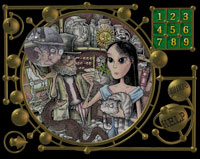
We celebrated Planetarium’s tenth anniversary — on 09/09/09 — with the publication of a new Beholder project: The Knot-Shop Man, a set of books tying together four stories about Arxnodorum and the knots of fate.
There are still sets of The Knot-Shop Man available, and if you enjoy the writing in Planetarium then of course we think you’ll probably love these books too. Unlike Planetarium, The Knot-Shop Man is not an explicit puzzle story, but the books are no less unique and thought-provoking.

About the Puzzles
I can’t solve it. Can I have a hint or a clue?
No you can’t! The riddles and puzzles are the clues. There are additional hints and clues in the text and in the pictures . . . if you know where and how to look, of course. Sometimes a hint or even part of the solution is concealed in a later part of Planetarium, so if you can’t solve a puzzle right away, something might appear later on in the story that will help you.
How many puzzles are there in total?
There are twelve word-puzzles, twelve number-puzzles and twelve general puzzles in Planetarium, which total thirty-six solutions. These are the Minor Puzzles of Planetarium. The solutions to the Minor Puzzles themselves are keys to the Major Puzzle.
Are the puzzles easy or difficult?
There are some very easy puzzles, and some difficult ones. If you find you have to do a lot of calculation or hard work to solve a problem, it might be that you have missed an easier way to solve it. But then again, it might not. The Major Puzzle itself is not necessarily the hardest part of Planetarium.
Some of the more mathematical puzzles in Planetarium are actually quite well-known — in one form or another — amongst the kind of mathematicians who study such things. Remember that at the end of Planetarium, we’ll show you all the solutions anyway.
What is the Major Puzzle?
The solutions to all the Minor Puzzles form the key words and numbers that you need to solve the Major Puzzle. By the time you have accumulated all the solutions to the thirty-six Minor Puzzles, you should have worked out what the Major Puzzle is and the way to use the minor solutions to solve it. The Major Puzzle is not described explicitly anywhere within Planetarium.
I can’t find one of the Minor Puzzles. Where is it?
Ah, good question. Towards the end, especially if you are trying to change one of your answers, you’ll wish you’d remembered where you found them all. Memory is one of the things that the story is all about, after all. You have to find the puzzles for yourself. There are three minor puzzles in every part of Planetarium: one keyword, one keynumber and one “either-or” puzzle. They are not really hidden — you don’t have to look very hard to find them — but you may have to click on the right characters or objects in the picture to get there.
Are there things hidden in the HTML?
Absolutely not. Planetarium is a puzzle, not a trick.
There is no hidden significance to filenames in any URLs, or in the mechanism of the website or the construction of the pages, or anything like that.
Also, just as you would expect, instalments are static — when you look back at a previous instalment (which, as the story progresses, you may well want to do), nothing in it will have changed.
About the Solutions
How do I know if my answers are right?
This has turned out to be the most commonly asked question but for two slightly different reasons, so we’ve updated it to have two answers. First, the factual answer:
You can’t be sure until the end (when we show you all the solutions). When you submit an answer, it is not checked until your Table is frozen. It’s merely placed in your Table of Solutions, right or wrong. If you try to submit an answer that’s too long, or contains invalid characters, Planetarium will warn you, but otherwise what you put in your Table is up to you.
Here’s the other answer:
Over the years it’s become clear that this question is often asked by someone who is complaining that they don’t get an immediate confirmation that they have the answer right. This comes up again and again and what we think it’s really about is that many people want Planetarium to behave like a game in this regard. Well, it’s a very deliberate (and, perhaps, interesting) aspect of Planetarium’s design that it doesn’t behave like that: it’s a story puzzle, not a game.
So if your question is really:
“I only made a reader-name so I could find out if my answer to the riddle in part i was right, so is it?”
then the answer (and this turns up in about half of all online discussions about Planetarium) is almost certainly:
No, your answer is not right. Everyone who solves that riddle knows beyond doubt that they have the right answer, because it is a good riddle.
Incidentally, this is true of most* of the puzzles in Planetarium, according to those who comment on such things in the xiii forum.
* The exceptions are discussed in the forum, but it’s fair to say that the answers which people find the hardest to be confident about tend to be some of the more difficult either-or puzzles. See the answer to It’s almost impossible to solve, isn’t it?
Can I change my answers if I change my mind?
Yes. Any time before your Table is frozen, you can re-submit any of the answers you have in your Table of Solutions. The only way to change any of the minor solutions is to go back to the place where you found the puzzle originally. Simply submit a new answer and it will overwrite the old one. You can also delete an answer by submitting a blank answer — although, of course, a blank answer is never the correct answer.
Can I delete an answer I’ve submitted?
Yes. You can change any of your answers (see the previous question), and instead of typing a word or a number, just leave it blank (or choose undecided for an either-or puzzle). Typing 0 for a keynumber is the same as deleting it. Furthermore, if you have entered anything as part of your major solution, you will see an option underneath your Table of Solutions to reset it to be blank.
How do I submit my solution when I’ve finished?
You don’t need to do anything to submit your answers at the end, because you submit them as you go along. If you have finished, and think you have the correct solution in your Table, you’ll have to wait agonizingly for your table to be frozen at the end of your twelfth week. Just make sure that your table of solutions is as complete as you can make it in time for that.
Will the solution to the puzzles ever be published?
Yes. When you finish Planetarium, regardless of whether you were trying to solve any of the puzzles or not, your Table of Solutions will be frozen and, for the thirteenth week, we will show you the complete set of Planetarium puzzle solutions — and their illustrated explanations. After that, your time here will have ended and your reader-name will expire. After your thirteenth week, you won’t be able to log in any more (except by starting again, of course).
Why don’t my answers go into the right place in my Table?
They do go into the right place. The answers to the minor puzzles don’t necessarily go into the part of the Table of Solutions where you found the puzzles themselves.
About the Competition
What is the prize?
There is no prize. Planetarium is first and foremost a storytelling project on the web, and we hope you join in because it’s entertaining, not because you’re motivated by some greedy Winner Ethic, heaven forbid.
When it started, there was a competition to be the first person to solve it, but that’s been done now so you’re too late. But you didn’t miss out on a prize because there wasn’t one.
When did the Planetarium competition start and end?
The competition ended thirteen weeks after Planetarium opened for registration on 9/9/99.
But now it’s begun, Planetarium will always be here. The story runs for twelve weeks — starting from the time you registered. There are twelve weekly parts to the story — and thereafter, the thirteenth week is for reading the solution, and then your reader-name will expire, and it’s all over. Unless you register to do it all over again, of course . . .
What happens if I don’t solve all the puzzles?
Nothing at all. You don’t have to solve any of the puzzles to enjoy the story. It’s up to you how hard you want to work at solving them all before your thirteenth week, when you’re shown the answers anyway.
About the Story
Can you remind me whenever a new instalment is available?
Yes. There are three ways to be reminded: by email, by adding a calendar event, or by using the RSS feed.
New instalments are released weekly, counting from the moment you registered, give or take a few hours. We do realise, though, that it’s just possible that you have other things to do in your life besides wait for this weekly event, so you might miss it. Planetarium provides three mechanisms to help you:
-
Reminder email
If you provide an email address when you register, Planetarium will send an email when it looks like you might miss an instalment (that is, if you don’t log in for over 10 days or thereabouts). Be aware that such automatic emails may be shot down by your anti-spam software. You can look out for them because they come from the beholder.co.uk domain and have the subject line Planetarium reminder. -
When you log in, or try to look at a future instalment before you have access to it, you’ll see a calendar icon. Click on that to get a calendar event for the first full day when you’ll have access to the next instalment. This uses the universal ical format, which means that (depending on how your device is set up) the event might be automatically presented to your calendar application or else downloaded so that you can add it yourself. Calendar entry
 -
There’s a personalised RSS feed (what’s that?) — subscribe to it from the welcome screen when you log in by clicking on the RSS icon. Once you’ve done that, your RSS reader will let you know when the next instalment is available. RSS feed
Of course, you don’t need to read an instalment the moment it is released . . . but if you’re seriously attempting to solve the puzzles, the later you leave it (especially towards the end of the story) the less thinking time you’ll have.
I can’t make any sense of the story. What’s going on?
You can’t follow the story in quite the same way as a normal story, because the narrative is divided between the various characters within it. Note, though, that you can enjoy the story without solving any of the puzzles. Similarly, a complete understanding of the events within the story is not necessary in order to solve the puzzles, although sometimes it may be helpful.
Is it possible to find out what the love-letter in the first picture actually says?
Yes it certainly is, although strictly speaking this in itself does not occur as one of the Minor Puzzles nor the Major one.
What happens if I go on holiday and miss an instalment?
Planetarium will try to wait for you.
If you miss a week or two, your reader-name will be suspended — effectively Planetarium waits for you if it detects that you’ve skipped an instalment by more than a couple of days (that is, a whole week passed without you seeing the new instalment and then the instalment after that one has also been released). When you log in, you’ll be told that your reader-name has been suspended, and you should follow the link to re-enter the story.
Note, however, that technically we don’t allow you to unsuspend a reader-name in the thirteenth instalment.
If you followed that, you’ll see that you really don’t want to rely on this mechanism for the final instalment (xii). The fact is (and some people have been quite grumpy about this) that if you really get into Planetarium you should try to visit weekly. In fact, you should try to visit at the start of your week (which will depend on what day you started it). People have struggled with the hardship of missing instalments since as long ago as the 18th century (when Sterne was writing his masterpiece Tristram Shandy), so we already feel we’ve gone the extra mile by providing this suspension mechanism, even if it doesn’t quite work at the very end.
In fact the suspension lasts for about three weeks — any longer than that and Planetarium assumes you’ve lost interest (many people do; it’s the Internet, after all), and your reader-name is automatically deleted. If you know you’ll be away for a couple of weeks and you want to be sure you won’t lose your place in Planetarium, you should log in just before you go. If you return within three weeks, you should still be able to resume (although note that caveat about the final instalment, above).
So much for automation. If you know you’re going to be off-line for an extended period and this mechanism isn’t going to work for you — or you’ve just missed the end of the story and you’re grumpy about it — get in touch and we can sort something out human-to-human.
What’s this about Blue Fuel and the Device for Generating Chess Openings?
In part iii of the story, there’s a description of an odd device in the mathemagician’s laboratory that has been troubling Planetarium readers for years (you’ll need to be logged in to see it, but if you are, it’s this page). Without giving too much away, people who get to the end of Planetarium generally agree that there aren’t any loose ends flapping around, apart from that one thing standing in the corner of the laboratory, distilling blue fuel made of beeswax, beer, beetle-bones, borax and blue bath-salts.
Well, there is an explanation for it, but despite it being a topic of speculation amongst readers in the xiii Forum, nobody ever demonstrated that they knew what it was. But then, nine years and eight months after Planetarium was released, finally someone worked it out. Reader Jephly, nudged by the merest of hints, ended years of puzzlement by posting the correct — and relatively simple! — explanation in the xiii Forum. If you’re in your final week, you can see it in this thread.
About Technical Things
Is there an RSS feed for Planetarium? Where is it?
Yes there is (since April 2007) and it’s a good way to be notified when new instalments are available. It’s personalised (on your reader-name) so for this reason you only see the link when you log in.
If you want to subscribe and you missed it, just
log out
and log in again. Look for
the  icon on the welcome page.
Remember that Planetarium provides two other ways of being reminded if you don’t or can’t use RSS.
The pictures are too dark/small/fuzzy. What can I do?
In 2015, we updated Planetarium so that the main illustrations are bigger than they were. We’ll add support for retina-screens in due course.
But rest assured, there are no really tiny details hidden in the pictures, so in general you won’t be missing a clue. If you’re squinting really hard to spot something — especially if you’re doing it to solve a puzzle — then maybe that’s a warning sign that you’re missing a better way to get to the answer.
I registered but I can’t log in. What’s wrong?
The most common reasons for problems, in order of most to least likely:
- expiry — you didn’t log in for about a month
- typing error due to nerves/excitement
- CAPS LOCK on but lowercase letters in password
- your browser isn’t handling cookies
- ghastly system error at our end
Ideally, you should try to log in once a week. This is because Planetarium controls the release of instalments carefully, and you are discouraged from skipping instalments. If you don’t log in for a couple of weeks, Planetarium will let you back into the story roughly where you would have been if just a week had passed since your last visit (effectively it suspends your account until you come back in). See the FAQ answer about going on holiday for more about this.
If you don’t log in for a longer time — around a month — your reader-name will be automatically deleted. That’s fine with us — reader-names simply expire when they’ not used.
Assuming that that is not the case . . .
If, after you log in, Planetarium tells you that you have not been identified, there are several things to check before asking us for help. Firstly, make sure you’re spelling your username and your password correctly, and that includes UPPER and lower case — check that you haven’t pressed CAPS LOCK on your keyboard by mistake.
It may be that you are using a browser which does not support the login mechanism we are using. All recent browsers support so-called “cookies”, which Planetarium uses — but it is possible to switch this feature off. If you see the Welcome message after logging in but then get asked to log in again as soon as you try to enter Planetarium beyond part i, then you probably have disabled cookies somewhere in your browser’s configuration. Look in the options/preferences settings of your browser and switch cookies back on if you want to take part in Planetarium!
If Planetarium encounters a system error while you’re logged in (you should know if this happens because it will try to tell you), your session will be terminated and you should log in again. Similarly, you may be “timed out” — Planetarium will tell you if this has happened, and if you want to continue you can simply log in again.
How can I be sure nobody else can see my Table of Solutions?
Make sure you don’t use a password that is easy to guess. Also, when you log in, Planetarium will recognize you for the rest of that session. This means that if there is a possibility of anyone else using the same browser after you, you should either click on one of the log out links at the bottom of the screen, or else close your browser. Either method effectively “logs you off” from our server. For your protection, Planetarium also times you out after an extended visit. You’ll be asked to log in again — please tolerate this as we’ve tried to strike the right balance between security and inconvenience for you.
If you know that nobody else is going to be using your computer — you are at home, for example — then you don’t really need to worry about logging out. You’ll be timed out automatically when you have finished.
Have I got the right kind of browser, or am I missing something?
You need a browser which can display both .jpeg and .gif images (including animated GIFs), and which supports client-side maps and cookies.
The image to the right is an animated GIF, which should appear to be rotating. If it isn’t, something is wrong. It’s unusual but possible to switch animation off, but sometimes browsers simply get confused. Try quitting the browser and restarting it — that often does the trick.
It was a deliberate and compassionate aspect of Planetarium’s original design that there was no requirement to handle Java, Javascript, frames, nor to have any kind of plug-in.
However, in 2015 we changed the CSS so that the main images change size depending on the width of your browser window. We can only let this happen if JavaScript is enabled (your browser needs to recalculate the coordinates of the “hotspots” so it knows what you’ve clicked on in the illustration). So, it’s true to say you don’t need it, but — especially on narrow screens — Planetarium now works best with JavaScript enabled.
At the same time, we moved Planetarium onto the same responsive framework (Zurb's Foundation) as the main Beholder site. This makes life easier for us and generally means it now works nicely on a wide range of modern devices, especially mobile phones. Foundation uses media queries, which means things might look bad in very old browsers. We've added the respond.js polyfill so things should still work in Internet Explorer 8... 7... and even 6. But really, the web has changed since Planetarium was launched, and we don’t feel too bad about not supporting bad old browsers any more.
Server-side maps were removed from the HTML in 2006. We don’t think there are any browsers out there these days which benefit from this mechanism any more, and nobody has complained about it so it looks like we were right.
There is no video in the main story, but in 2022 we added video
animations to two specific solution pages (that’s for your thirteenth
week). One replaced a stuttering animated GIF that’s now been
retired. We’ve used webm and mp4 formats,
both of which are now widely supported on the web, and in neither
case are they essential viewing.
I’ve forgotten my password. What can I do?
Oh dear. This will be particularly upsetting if you have got as far as week 11 already. You have to try hard to remember it. The fact is we do not re-issue passwords.* We can’t tell you what it was even if we wanted to, because it was encrypted as soon as you registered. Consider remembering a secret word for thirteen weeks as part of the challenge which is Planetarium, if this helps.
* This seems uncharacteristically harsh but it’s the flip-side of the fact that you probably registered anonymously. We usually can’t know for certain that whoever is asking for a new password is who they say they are. A Planetarium password may grant access — not always, but sometimes — to the results of over eleven weeks of hard puzzle-solving effort, which is something we won’t risk handing over to the wrong person.
I think I’ve found an error. What should I do?
Politely and promptly let us know, please. We will fix it as fast as we can so that nobody else gets snagged on it. If it’s something inside the story, it might not be a mistake — please understand that if that is the case, we might politely refuse to get into a discussion about it since (a) it might qualify as getting “hints” which we’ve told everybody else we wouldn’t give you, and (b) as a general rule we are always admirably, desperately busy.
So, if you think you have found a problem, or something seems awry with the server, let us know on cartoons@beholder.co.uk and we will look into it as soon as possible. We do appreciate your help, and of course if something has gone wrong it’s more than likely that you have spotted it before we have.
About Something Else
What do you want my email address for?
If you just want to enjoy Planetarium, we don’t need your email address. Just leave it blank. Everything will work fine. The only reason for providing an email address is so that Planetarium can send you a reminder email if it looks like you are about to miss an instalment. Remember that Planetarium provides two other ways to be reminded (calendar events or RSS) that don’t need email.
If you do provide an email address, Planetarium only keeps it while your reader-name is active. Afterwards, it gets deleted. See also: Unsubscribe me from the reminder email.
We will never give or sell your email address to anyone else. If you thought we might, then you really haven’t got the hang of what Beholder on the web is all about. Shame on you. You must have missed the What’s the catch? question at the top of this FAQ.
If you are interested in knowing about other Beholder projects if and when they occur, we suggest you bookmark the home page and keep an eye on announcements. There is an occasionally-updated blog on the Fudebakudo site — since Fudebakudo is a Beholder project, then any major Beholder news will be mentioned there. There are RSS feeds on that blog, so you can keep an eye on what we’re up to that way.
Unsubscribe me from the reminder email!
If you want to explicitly remove your email anyway (or indeed delete your reader-name) contact us directly and a human will do that for you.
But simply doing nothing will result in your account being deleted anyway. That is, if you get a reminder email after you’ve already decided to quit Planetarium, just ignore it, don’t log in, and your account will run out without any more emails being sent (that is, Planetarium only attempts to send you a reminder once per instalment, so if you don’t visit the site after that, you’ll never get to the next instalment to trigger another email anyway).
Remember that Planetarium automatically deletes your account, including your email address (if you provided one in the first place, of course) when you get to the end of your thirteenth week or if you don't visit for a few weeks (whichever happens first).
What’s the xiii Forum?
The xiii Forum is a rolling message board only accessible to Planetarium readers in their thirteenth week — that is, readers who have reached the end of the story. You can read messages from readers who have passed through already, exchange comments with those who have finished around the same time as you, or leave your thoughts for readers who will finish later. Because all reader-names expire at the end of the thirteenth week, you only have access to the xiii Forum for at most seven days.
You’ll find links to the xiii Forum at the bottom of most pages in Planetarium.
Why’s instalment only got one L?
Because that’s the quaint way we spell it here. The text of Planetarium is in British English throughout (although strictly speaking puzzles could use other languages — mathematics, chemistry, even Latin if they feel like it). You’re probably only concerned about this if you’re trying to solve the puzzles, and we suggest you don’t worry too much — when the puzzles were written, we took care not to penalise readers who speak American English. There are a few places where we’ve added a note to clarify a peculiarly British turn of phrase where this might help you understand a puzzle, but you almost certainly would have coped without it anyway.

If you’ve got JavaScript enabled, Planetarium hides these notes for you and replaces them with a sphere like this so as not to distract you from the prose. Click on the sphere to reveal the note.
What’s a . . . . . . . . ?
Try looking in the Planetarium glossary.
What if I have a problem not covered here?
If you mail your query to cartoons@beholder.co.uk, we’ll sort it out for you as soon as possible. Don’t ask for extra clues or answers for the puzzles because we won’t give you any.